16 October 2015
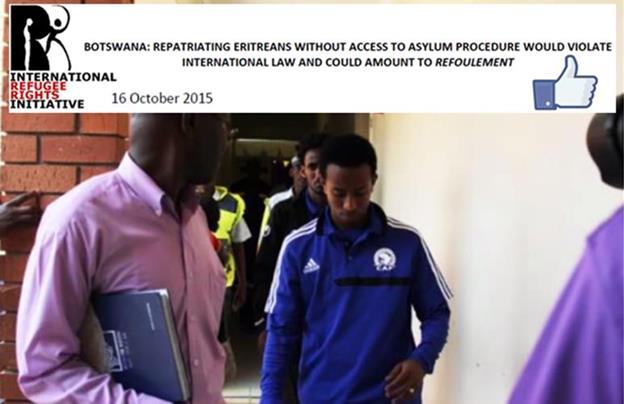
The International Refugee Rights Initiative expresses grave concern over reports that the government of Botswana plans to repatriate ten Eritrean asylum seekers without ensuring access to refugee status determination procedures and respect for the right to seek asylum and urges the government to respect its commitment to refugee rights and its obligations under law, and to demonstrate that commitment through transparent due process for asylum seekers in its territory.
The ten Eritreans, members of the Eritrean national football team, requested asylum after arriving in Botswana for a World Cup qualifying match. Similar asylum claims have received state recognition of risk of persecution faced in three preceding instances: in 2013, Uganda granted asylum to 15 Eritreans who claimed asylum while in the country for a football match; in 2011, visiting Eritrean footballers applied for asylum in Tanzania and in 2009, Kenya allowed the then Eritrean National football team asylum to apply for asylum.
According to the reports, Botswana’s Minister of Defence, Justice, and Security, Shaw Kgathi, dismissed the asylum claimants request for protection, suggesting that the footballers were not a governmental concern, but rather a FIFA concern, as they were visiting the country as footballers. However, under regional and international law, Botswana has obliged itself to respect the right to seek asylum, as well as providing access to and protection throughout refugee status determination procedures. International law makes clear that it is receiving governments and not any other organisation that bears the primary responsibility for ensuring respect for the right to seek asylum.
Botswana is bound by both the 1951 Convention Relating to the Status of Refugees, which it ratified in 1969, and the 1969 OAU Convention Governing Specific Aspects of Refugee Problems in Africa, which it ratified in 1995. Both provide protection against refoulement, which is the return to a territory where a refugee may face a risk of persecution. International law makes clear that states have an obligation to allow access to asylum procedures and that no refugee shall be removed by any means whatsoever, including denial of access to status determination procedures.
It is well documented that Eritrean asylum seekers are at risk if they return to Eritrea as demonstrated by the large number of moratoria on returns, large and increasing numbers of Eritrean refugees registered with UNHCR, reports of arbitrary and prolonged detention of deportees, and a “shoot to kill” policy in place for Eritreans attempting to flee the country.
Read online.
